Geomancy Oracle Widget
Cast four elemental lines by chance and let the 16 classical figures of Western geomancy speak - from the great fortune of Fort. Embeddable domain-locked widget, mobile-responsive.
Description
About This Widget
Geomancy is the most systematically organized of all the Western divinatory traditions that do not rely on astronomical calculation. It does not require a birth date, a card deck, or a symbolic vocabulary built over years. It requires four lines and the ability to read the sixteen figures those lines can form. Medieval scholars called it the "most perfect" of the arts of divination - high praise in a tradition that included astrology, palmistry, and alchemy in the same breath.
What Geomancy Is
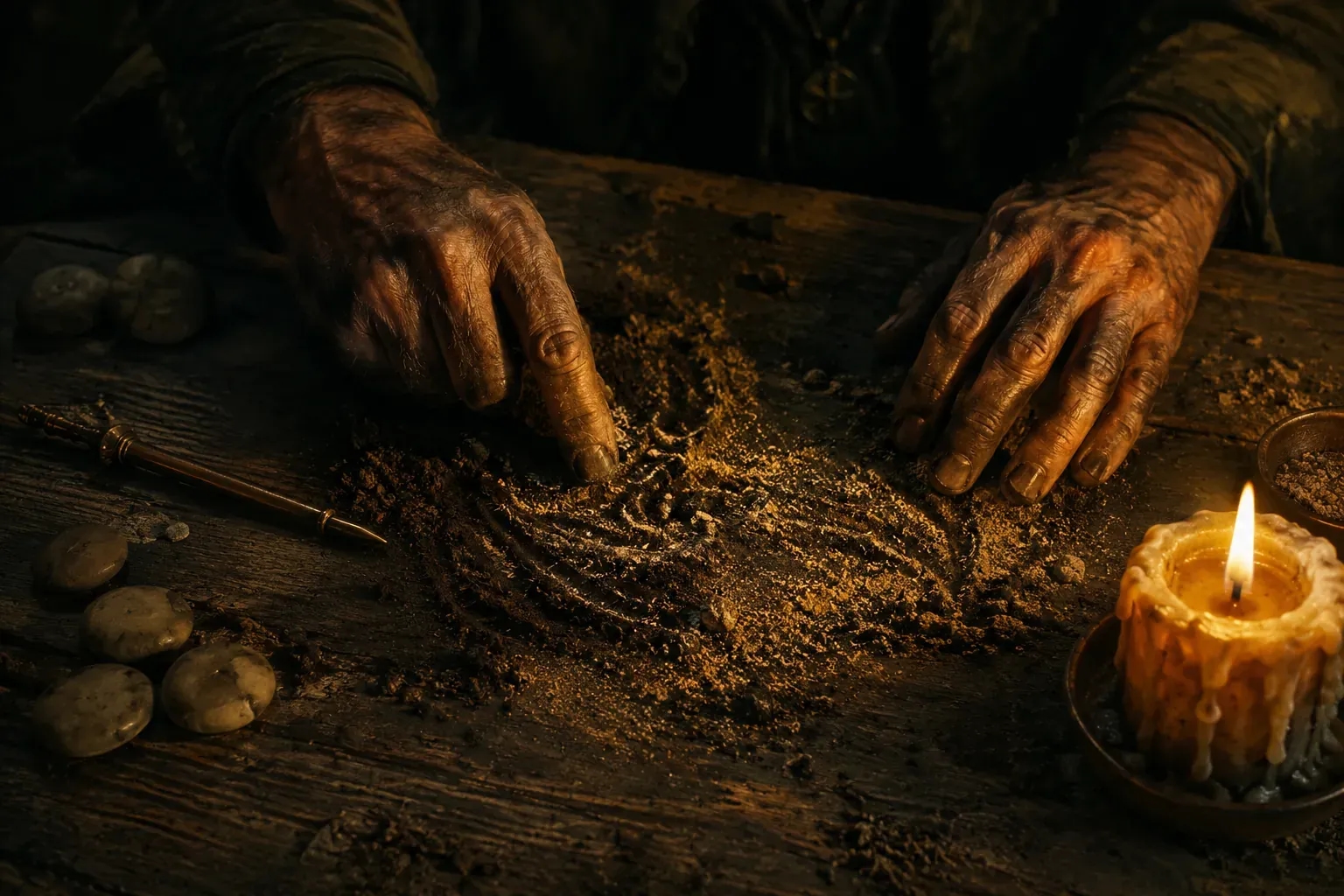
The word comes from Greek: geo (earth) and manteia (divination). The oldest Western documentation of the system dates to Arabic manuscripts from the 9th and 10th centuries - it was called 'ilm al-raml, the science of sand, and involved making random marks in sand or earth and counting them. By the 12th century, geomancy had moved into Latin Europe through translations in Spain and Sicily, and by the Renaissance it was a standard part of the astrological-divinatory curriculum. Cornelius Agrippa devoted a full chapter to it in his Occult Philosophy (1531). John Dee practiced it.
How the Cast Works
You generate four rows of dots, each row produced by a random process - traditionally by stabbing the earth or sand repeatedly, then counting the marks and noting odd or even. Here, four elemental lines are generated: Fire (top), Air, Water, Earth (bottom). Each line resolves to either a single dot (odd) or a pair (even). The resulting four-line figure is one of the sixteen classical geomantic figures.
Only sixteen possible figures exist. That is a small closed set, and it is what gives geomancy its precision: unlike a tarot deck of 78 cards, the sixteen figures are exhaustive. Every question you can ask is answered by one of them.
The Sixteen Figures
Fortuna Maior (Greater Fortune): all lines doubled, two by two by two by two. The most powerfully auspicious figure in the system. Success through one's own sustained effort. Whatever is in motion is moving well.
Fortuna Minor (Lesser Fortune): a complementary figure to Maior, but more provisional. Good outcomes that require external support or favorable timing to materialize.
Acquisitio (Gain): associated with Jupiter. The energy of accumulation, success in material and practical matters. Getting what you sought.
Amissio (Loss): the inverse of Acquisitio - things in the process of leaving, passing away, or being released. Not always negative: sometimes release is exactly what is needed.
Laetitia (Joy): Jupiter again. An upright, open figure - happiness, health, good prospects. One of the clearest positive signs.
Tristitia (Sorrow): the obverse of Laetitia. Delay, heaviness, the need for patience. Not disaster, but a slow season.
Puer (Boy): Mars energy, fast and sharp. Conflict, courage, action, sometimes recklessness. A figure of intense forward movement.
Puella (Girl): Venus energy. Beauty, pleasure, harmony. Positive in emotional matters; can indicate a focus on appearance over substance.
Rubeus (Red): Mars again, but turbulent - passion tipping into chaos. A warning to pause before acting.
Albus (White): Mercury's wisdom. Clarity, thoughtfulness, the right conditions for careful deliberation. One of the most auspicious figures for questions requiring good judgment.
Via (Road): the Moon, movement, travel. A figure of change and transition - things in motion, not yet settled.
Populus (People): the Moon again, but multitude. Groups, communities, collective movement. Good for questions about social matters; neutral for personal ones.
Conjunctio (Conjunction): Mercury, connection and joining. Meetings, partnerships, things coming together. Read in relation to what is being joined.
Carcer (Prison): Saturn. Restriction, delay, limitation - but also stability when stability is what the situation needs. Depends entirely on context.
Caput Draconis (Head of the Dragon): a threshold figure. Beginnings, the opening of cycles, the entry point into new territory.
Cauda Draconis (Tail of the Dragon): the complementary threshold - endings, conclusions, leaving what has run its course.
Hold your question, cast the figure, and read what the earth reveals.
Delivery & License
Secure domain-locked iframe - renders only on your licensed URL. One-line embed, issued immediately after purchase. Mobile-responsive, dark/light via CSS variables. English language.
Delivery
iFrame Embed
License
Single Domain
Domains
1
Live Preview
Integration Options
Showing the Dark preset — the highlighted theme value below and the live preview above update with your choice.
Copy and paste into any HTML page, WordPress block editor (HTML block), or website builder. Replace YOUR_API_KEY with your key from the dashboard.
<!-- EsoTier Widget: Geomancy Oracle Widget -->
<iframe
  src="https://esotier.com/widgets/geomancy-oracle?key=YOUR_API_KEY&theme=dark"
  width="400"
  height="500"
  frameborder="0"
  loading="lazy"
  title="Geomancy Oracle Widget"
></iframe>Sign up free to get your API key and replace YOUR_API_KEY.
Geomancy Oracle
Cast four elemental lines by chance and let the 16 classical figures of Western geomancy speak - from the great fortune of Fortuna Maior to the gentle wisdom of Albus.
How it works
- 1Hold your question in mind - geomancy works best with a single clear intention
- 2Tap Cast the Figure to generate four random elemental lines from Fire down to Earth
- 3Read the classical Latin name and the full interpretation of the figure the earth reveals
Geomancy Oracle Widget
Cast four elemental lines by chance and let the 16 classical figures of Western geomancy speak - from the great fortune of Fort. Embeddable domain-locked widget, mobile-responsive.
Subscribe & embed
Renews each month - cancel anytime.
or own it forever with a one-time purchase